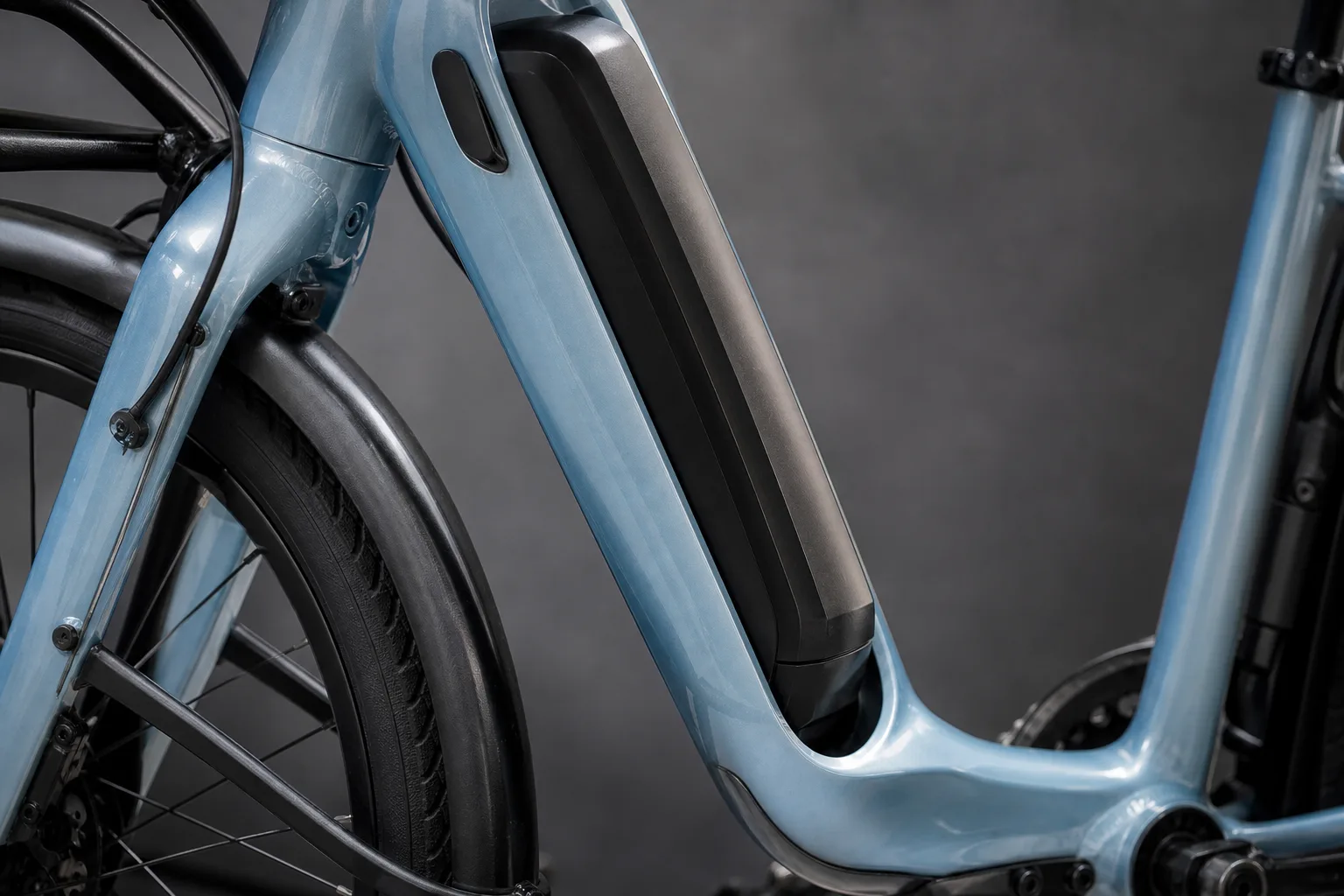
A rider with a fused right hip stood in a shop on a Tuesday afternoon with two step-through electric bikes side by side, both about the same weight on the scale, and pushed each one up the four-foot ramp to the sidewalk. The first went up crooked, the tail swinging out toward the parked cars, and had to be corrected twice with the wrist. The second tracked straight and needed one hand. Same weight, same tires, same ramp. The difference was that one carried its battery behind the seatpost on a rack and the other carried it inside the lower frame member, a few inches above the crank.
Why the walk matters more than the ride
Once a bike is rolling with a rider on it, mass low and central mostly disappears into the handling, and a lot of layout differences stop being noticeable at speed. Walking is the opposite. Pushing a bike by one grip, at maybe two miles an hour, with the frame tilted five or ten degrees toward you, turns the bike into a lever with your wrist at the fulcrum, and every pound behind the seat tube gets multiplied by its distance from the front wheel. Riders with limited hip or knee movement do this more than most, because they walk the bike out of the garage, through the door, up the curb cut, and into the elevator.
Three places the battery can live
In-tube on a step-through means the battery sits inside the long, gently curving member that runs from the head tube down to the bottom bracket, which on these frames is thicker and often oval in section for exactly that reason. That is the lowest and most forward of the three, and it is the one that walks best. Under-seat batteries, usually clamped to a short tube behind the crank or slotted into the seat mast, sit higher but stay close to the center, and the penalty is modest. Rear-rack batteries sit highest and furthest back, which is where the pushing complaint comes from, though they are also the easiest to remove and carry inside to charge.
A careful reader checks which of these a listing actually means, because the photographs are not always decisive and the phrase "integrated battery" gets used for all three. Look for a keyed slot and a hinged door on the underside of the low frame member, look for the charge port location, and ask whether the pack lifts out sideways, backward, or downward. Downward removal matters if the bike lives in a rack with a wall behind it. The Consumer Product Safety Commission is the federal body responsible for consumer product safety in bicycles and the lithium-ion packs fitted to them, and a shop that can tell you the cell certification without leaving the sales floor is usually a shop that knows the rest of the spec too.
Hub motor or mid-drive when the frame cannot triangulate
A conventional diamond frame gets its stiffness from two triangles. Drop the top tube for a low step and the front triangle is gone, so the frame resists twist through the depth and shape of the remaining tube, through the size of the bottom bracket junction, and sometimes through a second small tube running from head tube to seat tube. A mid-drive puts its torque directly into that junction. Good step-through frames are built for it, with a visibly reinforced shell and a wider weld footprint, and the result is a bike that keeps its weight centered and low. A rear hub motor puts the torque at the axle instead, which asks less of the frame and moves roughly six to nine pounds to the very back of the bike.
That is the trade in one sentence: the hub layout is gentler on an untriangulated frame and harder to push, while the mid-drive is more demanding of the frame and easier to push. Pair a rear hub with a rear-rack battery and the two rearward masses stack, which is the combination that swung out on the ramp. Pair either motor with an in-tube pack and most of the walking problem is solved before you touch the bike.
What to check on the floor
Push the bike, do not just ride it. Take it up whatever incline the shop has, one hand on the near grip, and feel whether the tail follows or argues. Lift the front wheel a few inches, then the rear, and notice which end is heavier and by how much. Tip it onto its kickstand and rock it back to vertical, since that is the motion a garage does twenty times a week. Then ask to remove the battery while the bike is on the stand, and see whether your hip lets you reach the release.
Two bikes with the same number on the scale can be two different bikes in the hands, and the ramp will tell you which one you are actually buying.